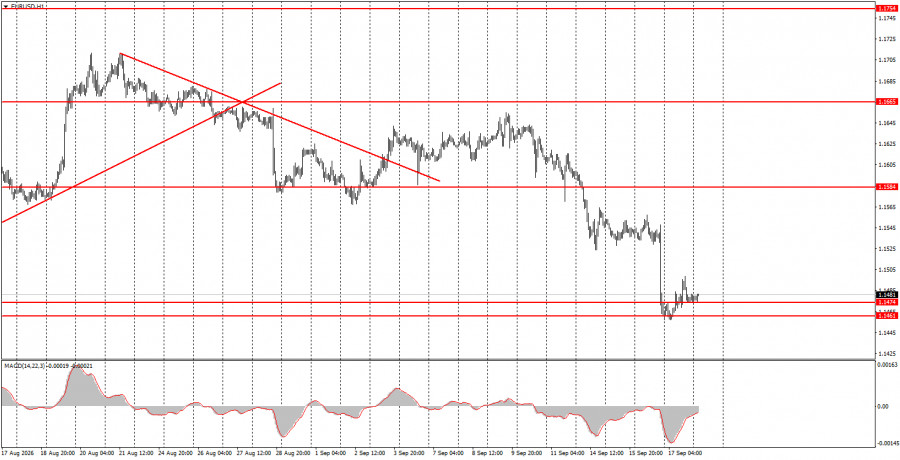
The EUR/USD pair plunged like a stone on Wednesday evening and tried to recover a bit on Thursday. It would be a stretch to say Thursday's macro events provided any support to the euro. We would not interpret them that way in the near term. After the market largely ignored the European Central Bank's second tightening, it is unrealistic to expect, for example, euro-area industrial-production data to spark a euro rally. Thus, the second estimate of euro-area August inflation and US construction-sector data were effectively ignored. The Bank of England meeting also had no impact on the euro or dollar — which makes sense because the BoE has little direct influence on the euro. Sometimes euro and pound move together in such cases, but not this time. The downtrend persists; today the pair may try to continue a corrective bounce.
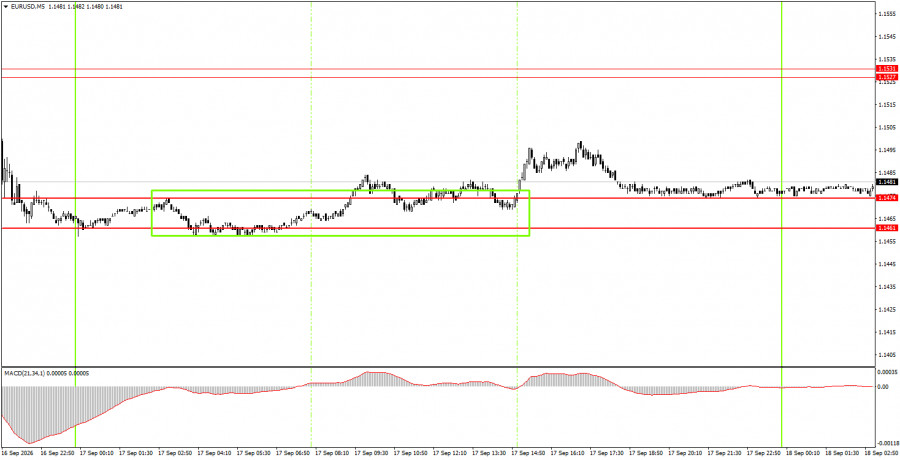
On the 5-minute timeframe on Thursday, one buy signal formed. During the Asian and European sessions, price tried to lift off the 1.1461–1.1474 area and eventually did. However, the euro advanced only about 15 pips in the intended direction, because volatility remained extremely low again.
On the hourly timeframe, EUR/USD continues a downward trend that may develop into a full-fledged trend. Considering recent months' events, we do not believe the euro should collapse like a stone — but the market's primary focus remains Federal Reserve policy, which this week turned materially more supportive of the US dollar.
On Friday, novice traders may open short positions targeting 1.1366–1.1377 if price consolidates below 1.1461–1.1474. Buy trades can be opened targeting 1.1527–1.1531 in case of a bounce from the 1.1461–1.1474 zone.
On the 5-minute timeframe, consider the levels 1.1267–1.1275, 1.1366–1.1377, 1.1461–1.1474, 1.1527–1.1531, 1.1584–1.1594, 1.1655–1.1665, 1.1745–1.1754. On Friday, ECB President Christine Lagarde will speak, and the US will publish industrial-production data. We view both as secondary and expect market moves to remain muted again today.
Price levels (areas) of support and resistance serve as targets for opening buy or sell trades or as sources of signals.
Red lines indicate channels or trend lines that show the current trend and the preferred trading direction.
The MACD indicator (14,22,3) — the histogram and signal line — is an auxiliary indicator that can also provide signals.
Important speeches and reports (listed in the news calendar) can significantly influence currency pair movements. Therefore, during their release, traders should approach trading with utmost caution, or exit the market to avoid sudden reversals against the preceding move.
Beginner forex traders should remember that not every trade can be profitable. Developing a clear strategy and practicing money management are key to long-term success in trading.
RYCHLÉ ODKAZY




















 Kontaktujte nás