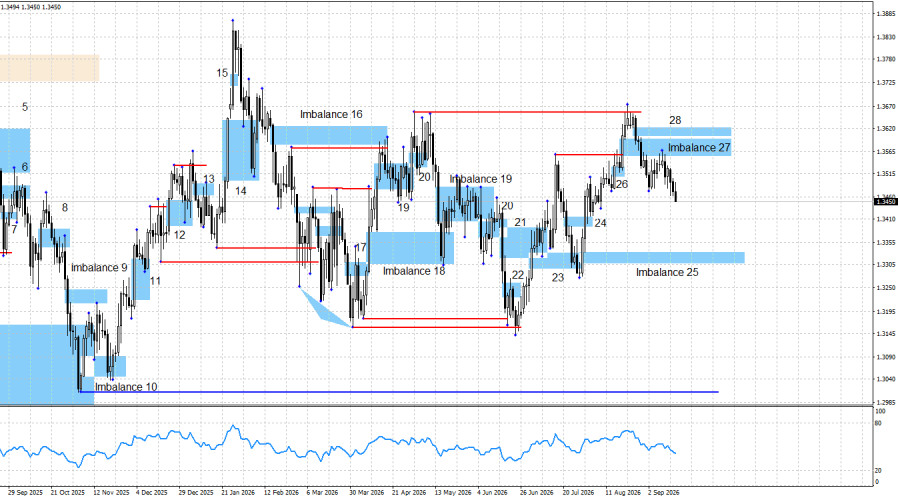
The GBP/USD pair has lost its bullish momentum, and at the current moment, the chart suggests that the pound sterling may continue to decline. The price reacted to bearish imbalance 27, which allowed traders to open short positions and created new, less favorable prospects for the pound. Unfortunately for the British pound, the UK inflation report provided it with no support. Although the Consumer Price Index rose to 3.1%, which should make the Bank of England's stance more hawkish, bears continued to exert pressure throughout the day. Traders continue to expect an FOMC rate hike, and this single factor is allowing the dollar to continue rising for the fifth consecutive day. Paradoxically, given the current events and market movements, I am not even sure that the UK regulator will be able to stop the pound's decline tomorrow, even if it takes the most hawkish position possible. A week ago, the market paid no attention to the ECB's hawkish decision; it is also ignoring the lack of clear hawkish prospects for the Fed, the problems facing the US economy, and many other factors that are clearly not positive for the dollar.
Over the past month, the dollar has faced numerous adverse factors, including the US Treasury's decision to increase purchases of long-term bonds, weak monthly Nonfarm Payrolls reports, a weak annual Nonfarm Payrolls report, a slowdown in the Consumer Price Index, slower GDP growth, and reduced market expectations for Fed monetary policy tightening. The only factors that have supported the dollar were the latest Nonfarm Payrolls report (for the first time in a long while) and the ISM Services PMI. Even the latest US inflation report was unfavorable for the dollar and did not increase the actual likelihood of FOMC monetary policy tightening.
Do the bears have prospects at the moment? In my view, there are few, but it should be acknowledged that the dollar has entered a favorable period. If the Fed decides to raise interest rates, the information backdrop for the dollar will become much more favorable. I do not believe this would trigger a prolonged decline in GBP/USD; however, in recent weeks, the market has been almost entirely pricing in an FOMC rate hike. What could prevent it from continuing to buy dollars for several more weeks against the backdrop of tighter Fed monetary policy?
Negotiations between the US and Iran have failed once again and are no longer taking place. From time to time, Iran and the US exchange strikes, threats, and ultimatums, none of which has had any effect on resolving the conflict or ending the war. No one can currently predict how much longer the conflict will continue. However, if it intensifies and escalates, the dollar could receive an additional source of support.
Chart analysis shows that the picture changed from bullish to bearish in just a few days after liquidity was taken from the May highs. The pound reacted to bearish imbalance 27, which triggered a new decline in quotations. Imbalance 25 could serve as the downside target. The Bank of England and Fed meetings could reverse the pair to the upside, but with each passing hour and day, it is becoming increasingly difficult to believe this will happen.
The economic news backdrop on Wednesday had no impact on the market, the pound, or the dollar. UK inflation rose from 2.9% year-on-year to 3.1% year-on-year, which had no positive effect on the pound. The market continues to focus solely on the Fed, a rate hike, Warsh's hawkish remarks, and higher rate projections in the dot plot.
The overall information backdrop remains such that, in the long term, I cannot expect anything other than a decline in the dollar. The war between Iran and the US has not changed my long-term expectations. Geopolitical developments prompted the market to remember the dollar's safe-haven status for several months, but the conflict has already passed its most active phase. The future of FOMC monetary policy remains uncertain, while the market continues to expect only tightening, which is the main reason for the bears' favorable sentiment. In my view, any rise in the dollar is temporary and driven by short-term factors. I would also note that GBP/USD has been trading in a range for an entire year. A range allows traders to expect virtually any movements within its boundaries. Traders have so far been unable to break out of the range.
News calendar for the US and UK:
The September 17 economic calendar contains six entries, among which I highlight the Bank of England meeting and everything related to it. The economic backdrop may influence market sentiment throughout Thursday.
GBP/USD forecast and trading advice:
The long-term picture for the pound remains bullish. In recent weeks, the bears have taken control of the initiative, and all recent bullish patterns have been invalidated. The liquidity sweep of the swing from May 1 allowed the decline to begin; a sell signal formed within inverted imbalance 27, and another bearish signal formed in imbalance 27 last week. Therefore, traders can now keep their short positions open, and there is room for further declines in both the euro and the pound. The current target for the pound is the 1.3307–1.3333 level. The outcomes of the Fed and Bank of England meetings could easily shift traders' sentiment to bullish, but it is unlikely that the developments today and tomorrow can be predicted in advance.
QUICK LINKS



















 Contact Us